
Decisions Under Pressure: How Asset-Based Flood Forecasts and Alerts Support Network Suspension Decisions

When rain falls and floodwaters rise, some of the hardest decisions are made quickly.
Should a utility shut down substations and de-energize distribution networks to protect assets and public safety? Should a transportation agency close a bridge before conditions deteriorate? Should a rail network close critical corridors and stop trains? Should field crews be pulled back before routes become impassable? Should a facilities manager isolate a critical site before flood conditions escalate?
These decisions are rarely straightforward. Act too early, and organizations risk unnecessary service disruption, customer outages and impacts, financial loss, and reputational scrutiny. Wait too long, and the consequences can be far worse: worker and public safety risks, equipment damage, emergency access issues, cascading service failures. Not to mention answering difficult questions in the post-event inquiries or investigations.
For utilities, transportation networks, rail operators, telecom operators, logistics providers, and any organization managing distributed physical assets over large geographical footprints, flood resilience is no longer just about protecting infrastructure. It is about making high-consequence operational decisions under pressure—and being able to explain and defend those decisions later.
That is where real-time, asset-based flood intelligence becomes essential. Asset owners and network operators who focus on enhancing the safety, security, reliability, and resilience of their network are investing in operational, impact-based forecasting and real-time, asset-specific flood monitoring and alerting to equip their network control centers, extreme weather experts, and business continuity teams for streamlined preparedness, response, and recovery.
The Challenge: Decisions Are Made Before the Full Picture Is Clear
Flood events rarely unfold neatly.
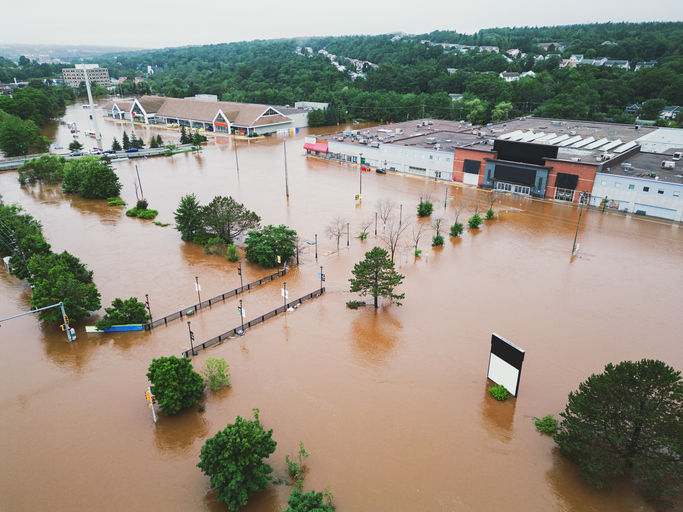
Rainfall intensifies beyond events previously experienced. Rivers rise faster than expected. A pump station, substation, rail corridor, depot, or communications site that looked manageable in the morning may be surrounded by water by the afternoon. The decision environment shifts quickly, and operational leaders are often required to act before conditions have fully developed.
In most organizations, that means working with a mix of regional weather warnings, stream gauge readings, field reports, and staff observations that arrive at different times, in different formats, with different levels of reliability.
That creates a difficult decision environment.
A flood warning may confirm that flooding is possible across a broader catchment of the region. What it typically does not tell you is:
Which assets are likely to be impacted, and when
How deep flooding could become at a given site
Whether access routes will remain open
Whether continued operation increases public safety risk
When flood waters have receded, and the environment is safe for inspection
The decision to suspend, shut down, reroute, or isolate part of a network depends on what is happening at the asset level, not just across the broader region.

What Network Suspension Really Means
“Network suspension” looks different across sectors, but the underlying decision structure is consistent.
For an electric utility, it might mean shutting down substations, de-energizing or isolating distribution networks, or delaying field work until access is safe.
For a water or wastewater operator, it could mean protecting pump stations, treatment assets, or vulnerable facilities.
For a transportation agency, it may mean closing roads, bridges, rail corridors, or depots.
For a telecommunications provider, it could mean restricting access to impacted sites or prioritizing backup power and restoration crews.
In every case, the decision carries consequences that affect customers, communities, revenue, service obligations, reputation, and public confidence. But continuing operations in unsafe or rapidly deteriorating flood conditions can expose people, infrastructure, and the organization to greater risk.
The right call is not always obvious in the moment. What organizations need is a clearer operational picture, one that connects flood conditions directly to their specific assets, operations, routes, and communities they are responsible for.

From Physical Resilience to Operational Resilience
Traditional resilience investment often focuses on physical infrastructure hardening: elevating sites and equipment, floodproofing facilities, installing barriers, or upgrading drainage. Those investments remain important. But physical resilience is only one part of the equation.
Operational resilience asks what happens during a live event:
How quickly can we identify which assets are at risk?
Can we move inventory, vehicles, or re-route distribution to avoid losses?
Can we act before crews, customers, or equipment are exposed?
Can we maintain service continuity where possible?
Can we reduce unnecessary shutdowns while still protecting safety?
Can we document why decisions were made?
Can we reopen energy or transport networks sooner after the floodwaters recede to limit business interruption and minimise revenue loss?
This is the shift that asset-heavy organisations are navigating: from protecting infrastructure in theory to managing operations dynamically in real time. The organizations that handle flood events well are those with the clearest operational picture when conditions deteriorate.
How Asset-Based Forecasts and Real-Time Flood Intelligence are Changing the Decision
When teams are deciding whether to suspend or continue operations, timing and specificity are everything.
A decision made too late may leave crews stranded, equipment damaged, or customers exposed. A decision made too early may create avoidable disruption. The goal is not simply to shut things down faster. The goal is to make decisions earlier, more selectively, and with better evidence.
FloodMapp supports this by overlaying live and forecast flood extent and depth against an organization's own asset and network data—substations, pump stations, road and rail networks, depots, towers, bridges, facilities, or service areas. The result is a real-time picture of which specific assets are currently impacted, which are forecast to be affected, and which access routes are likely to become unsafe. This picture updates hourly as rain falls and river levels rise. Automatic operation, 24/7/365, provides reliable, autonomous monitoring of your assets.
This equips operations teams with more actionable insight, providing a more practical basis for targeted action and a stronger foundation for decisions that need to be made quickly.
The Compliance Dimension: Decisions Need to Be Defensible
After a major flood event, internal leadership, regulators, inspectors, insurers, customers, and public officials may ask:
Why was this asset shut down?
Why was service maintained at another site?
When did the organization know conditions were unsafe?
What information supported the decision?
In these moments, documentation matters.
A defensible decision is one supported by clear, timely, and relevant information. Impact-based forecasting and Real-time asset-based flood intelligence can help create that decision record. By capturing flood extent, depth, timing, and asset-level impact, organizations can demonstrate that suspension decisions were based on the best available operational data, not guesswork, inconsistent field reports, or broad regional warnings alone.
Impact-based flood intelligence bridges the gap between operations and compliance.
It supports the team deciding in the moment, as well as the organization explaining that decision afterwards.
Reducing Both Overreaction and Underreaction
One of the less obvious benefits of asset-level flood intelligence is its potential to reduce unnecessary disruption.
Without precise visibility, organizations often default to broad protective action across a wide area because they cannot confidently distinguish between locations that are genuinely at risk and those that are not. That may be the safest available option, but it can also generate avoidable costs, service impacts, and operational complexity.
Better flood information allows for more targeted decisions.
A utility may identify that one substation requires immediate protective action while a nearby site remains accessible. An emergency management department or transportation agency may close a specific segment rather than an entire corridor. A field operations team may prioritize the sites most likely to become inaccessible in the next two hours.
Flood events will always involve judgment. But judgment exercised with specific intelligence produces outcomes that are more targeted, more timely, and more defensible.
Better Decisions Under Pressure
Flood-related decisions will never be easy. They involve trade-offs between safety, service continuity, cost, and accountability.
But they can be better supported.
With impact-based forecasting and real-time, asset-based flood intelligence, teams can act earlier, communicate more clearly, reduce unnecessary disruption, and create a stronger record of why decisions were made.
FloodMapp helps organizations make those decisions with greater clarity, confidence, and accountability.
Request a demo to see how FloodMapp can support safer, more defensible decisions before, during, and after flood events.


I love how the article explains using real‑time flood data to decide when to suspend services safely. It’s impressive how technology keeps us protected. After reading, I think I’ll unwind with a quick round of stickman racing for fun!
For puzzle lovers, efficiency does not have to mean rushing. 5 letter words can simply remove repetitive trial and error, leaving more time for the interesting part: comparing possibilities and interpreting clues. That balance makes it useful whether you are trying to finish quickly or prefer taking your time with each daily challenge.
The straight-talking approach stands out here: no fluff, just practical coverage of earning, strength, and gear. HMale keeps things focused on what actually matters for men who want to level up.
I keep a tab open with Crazyig for when I need a break during work. They have a decent collection of browser games that run smoothly without any lag. The racing and shooting categories are where I usually end up spending most of my time.
When a website includes an IBAN input field, an iban generator can help developers prepare fictional examples for testing. This makes it possible to check how the interface handles different inputs while keeping real financial information outside the development process.